
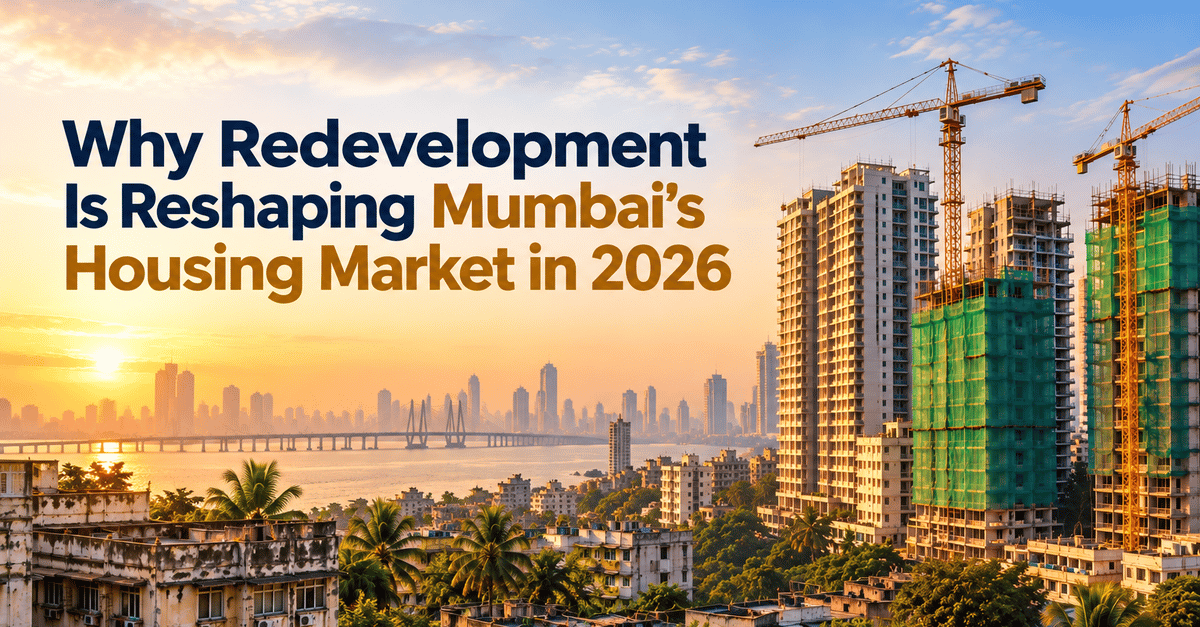
The skyline of Mumbai is beginning to take on a different appearance. In certain areas, the change is not obvious at first—then when you look up you can see green safety nets wrapped round one building then another. The older facades are vanishing, cranes have now become a feature of the landscape, and the buildings you know are being gradually replaced by taller ones.
It's not merely a tale about a construction project; it is one of the most clear indications of the direction in which the Mumbai real estate market will go in 2026. Redevelopment has now become a major component of the city's housing supply, since over 1,000 redevelopment projects have been launched since 2020.
The fact that is rather unpleasant is that Mumbai can never on forever just carry on expanding outward. Since developable land is limited, the shortage of such land in Mumbai's real estate market is causing the city to consider the land it already possesses.
Consider the idea of living in a walk-up building that is 30 years old.
The lift was never there at all; the staircase becomes more difficult to use when you're carrying groceries; what starts as a plumbing problem soon turns into a problem for everybody; parking then becomes the subject of daily negotiations; when the monsoon comes everyone suddenly realizes that the building needs repairing; and you continue to spend money on something that grows older each year.
Nevertheless, the land beneath that old building could be of immense value.
That is the strange fact about Mumbai; the issue is not usually that there is no room for development, but that some of the city's most valuable land is already used for buildings which were designed for a different kind of Mumbai.
What this means is that whenever you see the green nets being put up, redevelopment is not merely a matter of building a new building; it is Mumbai attempting to get as much housing, safety and usable space as possible out of land which it can no longer afford to waste.
The fact is that Mumbai cannot continue to expand outward indefinitely. Since there is a limit to the amount of land that can be developed, the city's real estate market is now experiencing a shortage, which is causing Mumbai to look at the land it already possesses.
Imagining that one lives in a walk-up building which is 30 years old.
The lift was never actually there; the staircase becomes harder to use if you're carrying groceries; what begins as a plumbing problem eventually turns into a problem for everyone; parking then becomes the topic of daily discussions; when the monsoon arrives, everyone suddenly realizes that the building needs repairing; and you keep on spending money on something that becomes older every year.
Yet the land under that old building might be of immense value.
The strange thing about Mumbai is that the problem is not generally a lack of room for development, but that some of the city's most valuable land is already being used for buildings which were designed for a different kind of Mumbai.
What this shows is that each time you observe the green nets being erected, redevelopment is not simply a matter of constructing a new building; it is Mumbai making an effort to get as much housing, safety, and usable space as possible from land which it can no longer afford to waste.
Mumbai cannot go on expanding outward forever since there is a limit to the amount of land that can be developed, and as a result the city's property market is now experiencing a shortage, which is causing Mumbai to turn to the land it already possesses.
Picture oneself living in a walk-up building which is thirty years old.
The lift had never really been there; the stairs become more difficult to use if you're carrying shopping bags; what starts off as a plumbing issue eventually turns into a problem for all of them; parking then becomes the subject of everyday conversations; upon the arrival of the monsoon, everyone suddenly realizes that the building needs to be repaired; and you continue to spend money on something that grows older each year.
The land beneath that old building could be of immense value.
What is strange about Mumbai is that the issue is not primarily a lack of space for development, but that some of the city's most valuable land is currently being used for buildings which were designed for a different type of Mumbai.
What this proves is that every time green nets are put up, redevelopment is not merely a matter of building a new structure; it is Mumbai attempting to get as much housing, safety, and usable space as possible from land which it can no longer afford to waste..
Mumbai will never be able to keep expanding outward since there is a limit to the amount of land that can be developed; consequently, a shortage now exists in the city's property market and this has led Mumbai to start using the land that it already possesses.
Envision living in a walk-up building that is thirty years old.
The lift had never really been a feature of the building; the stairs become harder to use when you're carrying shopping bags; what begins as a plumbing problem eventually develops into a problem for everyone; parking then turns into a topic of everyday conversation; and when the monsoon arrives everyone suddenly realizes that the building needs repairing; you also keep on spending money on something that becomes older every year.
The land under that old building has enormous value.
What is strange about Mumbai is that the problem is not mainly a lack of room for development, but that some of the city's most valuable land is being used for buildings which are designed for a different kind of Mumbai.
What this proves is that each time green nets are installed, redevelopment involves not just the construction of a new building, but Mumbai attempting to obtain as much housing, safety, and usable space as it can from land which it can no longer afford to waste.
This is most likely the first thing that residents notice following the redevelopment.
Consider the minor annoyances that occur in an older building in Mumbai. You return home late and have to search for parking on the streets. Your parents have to climb many floors since the elevator is unreliable—or indeed there is no elevator at all. There is also the ongoing concern during the monsoon or in the case of a fire emergency.
A modern tower eliminates these everyday difficulties since automated or multi-storey parking removes the nightly dispute over parking spaces, fast elevators make a real difference to senior citizens, families and anyone who has to carry groceries up from the entrance and proper fire detection systems, alarms, emergency exits and firefighting equipment also become part of the building's basic safety facilities rather than something that residents keep putting off.
The residential developments undertaken by Veena Developers in Mumbai provide a practical example of how modern housing projects are being designed with these practical facilities in mind, rather than just making the buildings taller or more attractive.
The true lifestyle improvement is not merely having a new lobby or a luxurious entrance, but having fewer small problems that are gradually spoiling your day.
For a current resident, the idea of redevelopment should mean more than just a new address.
This could refer to a more extensive or better thought out house, with modern building services and facilities which would have been impossible in the original building. But don't let the example flat lead you away from the paperwork.
Before buying into a redeveloped project, check:
The green nets form only the visible aspect of Mumbai's redevelopment story; there is a much greater change in the way the city makes use of its limited land.


